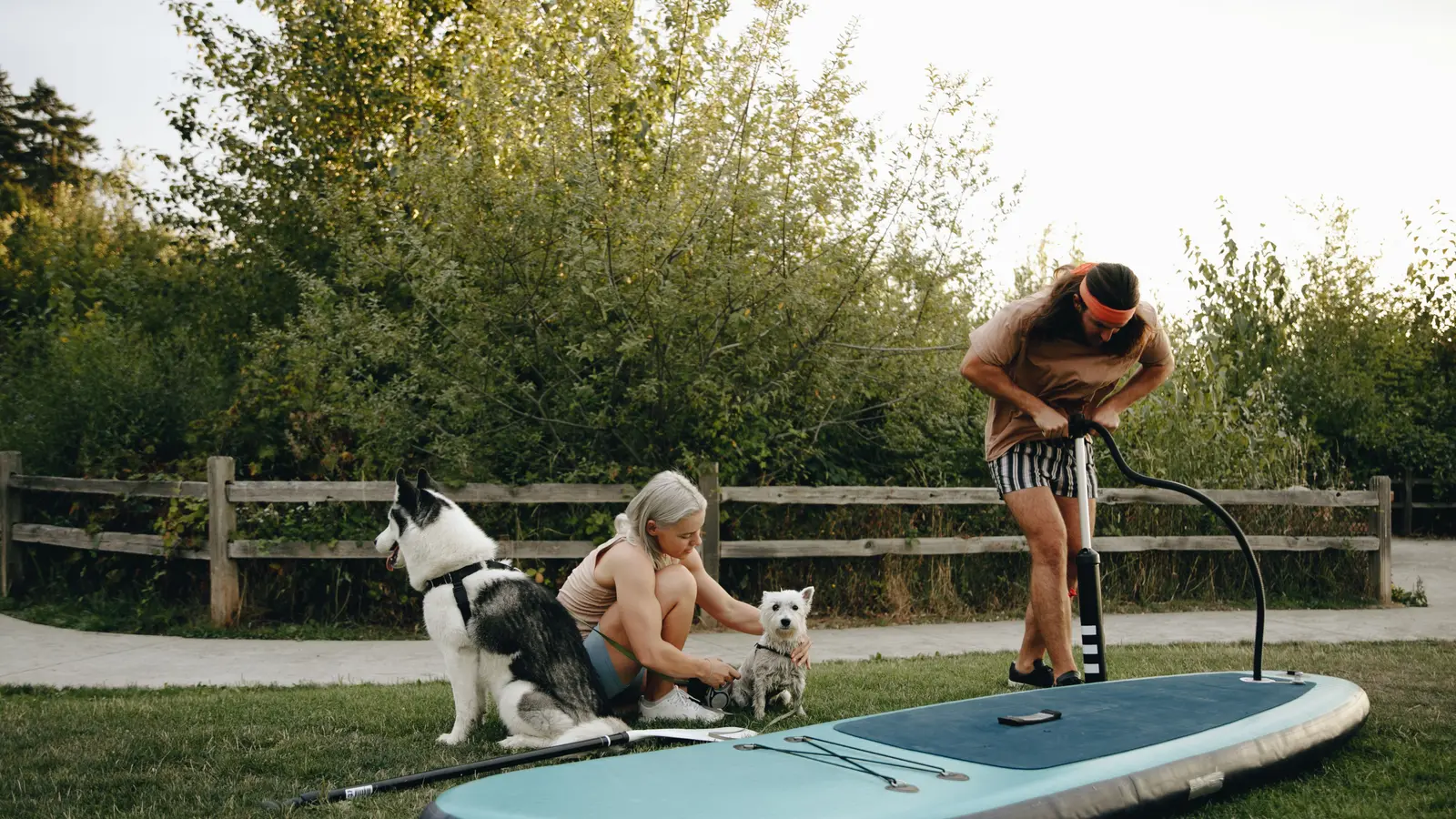

To inflate a paddle board, make sure the valve is closed, lock the pump hose onto it, and pump until the gauge hits the pressure printed on your board. For most inflatable boards that’s somewhere between 12 and 18 PSI, but it varies by brand, so the label beats any general number.
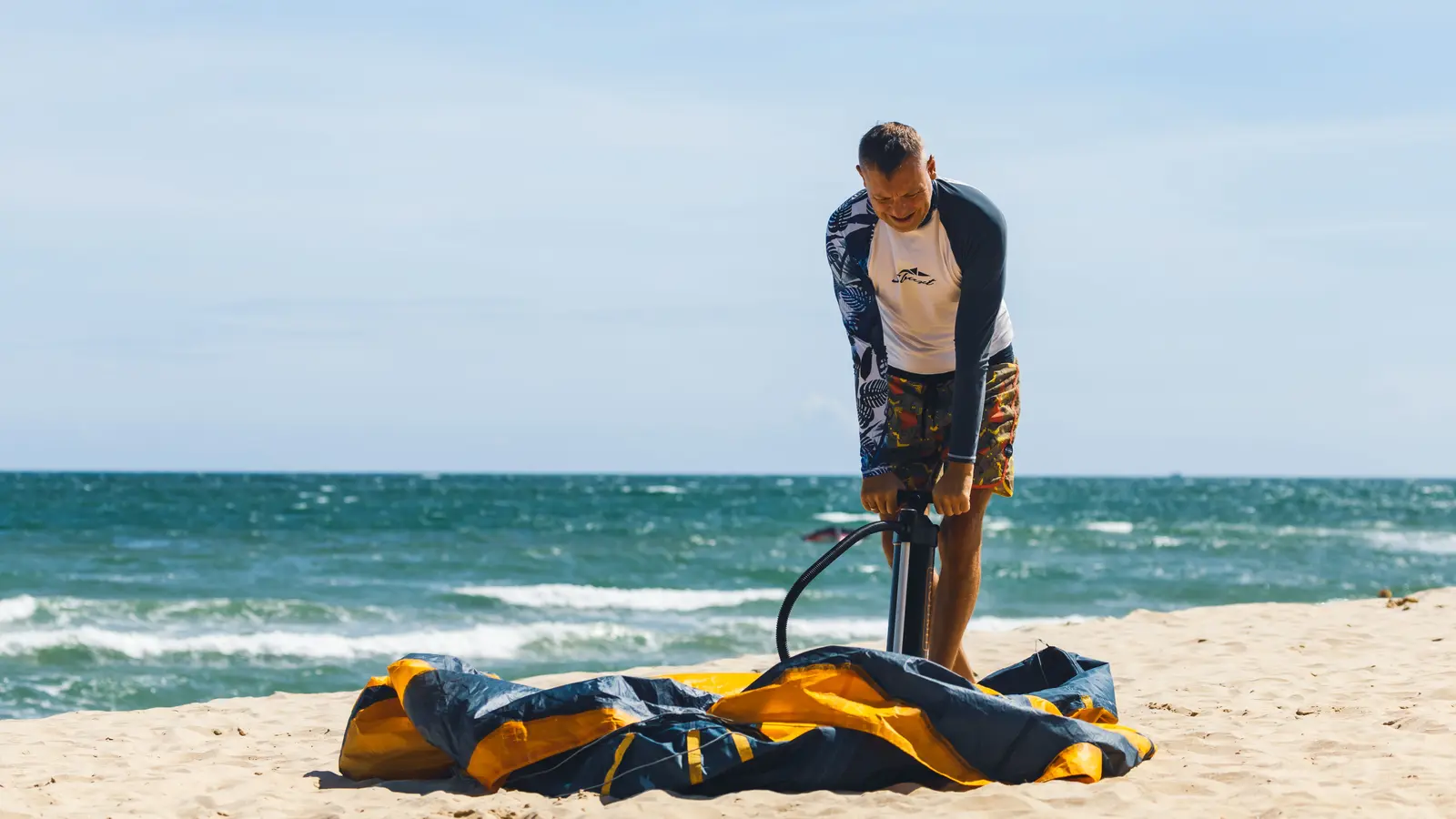
Photo: Serg Alesenko, Pexels License
The whole job takes about 5–10 minutes with a hand pump. Here’s how to do it without leaks or a soft board.
Quick answer
- Find your board’s PSI first. It’s usually printed near the valve or in the manual.
- Typical ranges: Glide and BOTE say 12–15 PSI. Starboard says 15–18 PSI. Newer NRS boards are rated up to 20 PSI.
- Close the valve before you pump, so air can’t escape when you remove the hose.
- Use double-action mode at first, then switch to single-action when it gets hard.
- Don’t trust feel. Read the gauge, and stop at the target.
Step 1: Set up on a clean surface
Unroll the board on grass, sand or carpet, free of sharp stones, sticks and thorns. Starboard and Glide both point out that a smooth, debris-free spot protects the bottom of the board. Lay it with the valve facing up and the fins down.
If your board has a removable fin, you can fit it now or after pumping. The Board Fitter can help if you’re still choosing a board, since inflatables come in many sizes and pressures.
Step 2: Close the valve
Most SUP valves are spring-loaded one-way valves. When they’re closed, air goes in but doesn’t come back out.
- Pin-style valves (e.g. BOTE and Starboard): make sure the yellow pin is up before you attach the hose.
- Leafield valves (NRS): push the stem down and turn it clockwise. It pops up to show it’s closed.
- Glide boards: press and twist the stem to lock it closed.
Nootica lists a pin pointing down as one of the most common mistakes, because the valve then leaks when you take the pump off. If your valve looks different, check the manual.
Step 3: Attach the hose
Remove the valve cap, push the hose connector on and give it a half turn to lock it. Some pumps need an adapter for certain valve types, so check yours fits before you get to the water. An unlocked hose is another mistake Nootica warns about.
Step 4: Pump
- Start in double-action mode. The pump then inflates on both the up and down stroke, which is faster.
- Use full strokes. Starboard suggests bending your knees and using your whole range of motion rather than just your arms.
- Don’t worry if the gauge doesn’t move. Many hand pumps don’t register until about 7–10 PSI (Glide says about 7, BOTE says 10).
- Switch to single-action when it gets hard. Starboard recommends this once most of the board is inflated, so you only push on the downstroke.
- Read the gauge mid-stroke. NRS notes that the needle on its pump falls back when you stop pumping, so read it while you’re pushing.
Two-stage pumps work the same way in spirit. NRS says to use the low-pressure stage for most of the air and the high-pressure stage to finish.
Electric pumps are easier. Glide says you plug in, connect the hose and set the target PSI, and the pump stops by itself. They can be noisy, as Nootica notes. Our best SUP pumps post covers the options.
Step 5: Stop at the right pressure and cap the valve
Twist the hose off, then screw the valve cap back on. The cap keeps sand and water out of the valve.
What PSI should you use?
Use the number printed on your board. If you can’t find it, check the manual or the maker’s website. Here’s what a few makers say:
| Maker | Pressure they give |
|---|---|
| Glide | 12–15 PSI (best at 15 for rigidity) |
| BOTE | 12–15 PSI |
| Starboard | 15–18 PSI (outer chamber on double-chamber boards) |
| NRS | Check the label; newer boards rated to 20 PSI |
These are the makers’ own figures. They’re not a universal rule, and boards differ.
Too soft: Nootica warns that an under-inflated board is less stable and can flex or deform, which raises the chance of falling in. SUPboarder Magazine also calls under-inflated boards a safety concern. For beginners, a firm board matters even more. See what size paddle board do I need for how volume and stability fit together.
Too hard: Overinflating can stress the seams. The maker’s maximum is the limit, so don’t go over it. A compressor without a gauge is a particular risk, according to Nootica.
Hot day: Air expands as it warms. Starboard tells people to fill only to 15 PSI when it’s above about 77°F (25°C), because the pressure will rise in the heat. If you leave a board in the sun, let some air out. Our guide to leaving an inflatable SUP inflated has more.
Double-chamber boards: Starboard says to fill the inner chamber first (to 10 PSI) and then the outer chamber, because filling the outer chamber first can push the inner one over its limit.
Gauges are worth checking
Pump gauges can be rough. If the board feels soft at the maker’s number, or you’ve had a bad pump, a separate digital gauge is a way to check. NRS sells one as an add-on.
How to deflate it
- Remove the cap and press the valve open (on Glide and BOTE boards, press the stem down and twist to lock it open; on Leafield valves, push and turn counterclockwise).
- Stand clear and let most of the air out, which Glide says takes about a minute.
- Roll from the nose toward the valve to push out the rest. Wipe the board dry first.
- Don’t tighten a valve on a fully inflated board, because Glide warns it can eject forcefully.
For rolling, folding and bagging, see how to pack an inflatable paddle board.
Troubleshooting
- The board loses air while you pump: the valve may not be fully closed, or the hose may not be locked. Release the hose, check the pin or stem, and start again.
- It goes soft after an hour: check the valve for sand and make sure the cap is tight. If air still escapes, look for a pinhole leak. Patch kits are inexpensive.
- The pump is too hard to push: switch to single-action or a high-pressure stage, and put your body weight over the pump.
Whatever pressure you land on, wear a leash and a life jacket on the water. Our guide on whether you need a life jacket on a paddle board explains why.
FAQ
What PSI should a paddle board be?
Use the figure on your board. Many inflatables sit between 12 and 18 PSI, and some are rated to 20. Starboard says 15–18 PSI; Glide and BOTE say 12–15 PSI.
How long does it take to inflate a paddle board?
Roughly 5–10 minutes with a hand pump, depending on the pump and your fitness. Nootica says 5 to 10 minutes.
Why won’t my pump gauge move?
Many hand pump gauges don’t register until around 7–10 PSI. Keep pumping.
Can I overinflate a paddle board?
Yes. Going past the maker’s limit stresses the seams. Stop at the stated pressure, and fill less on hot days.
Can I use a car compressor?
Some people do, but you need the right adapter and a gauge. Nootica warns that skipping the gauge can lead to overpressure. An electric SUP pump that stops at a set PSI is safer.