The right paddle board size comes from three things: what you’ll use it for (that sets the length), how experienced you are (that sets the width), and how much weight you’ll put on it (that sets the volume and weight capacity). Most adults start on a board about 10′6″ long and 32–34″ wide, which is why that’s the most common size sold.
Want the answer for you specifically? Our Board Fitter applies every rule in this guide to your weight, skill level and style of paddling, then shows boards that fit. It takes about 30 seconds.
Quick answer
- Length: under 10′ for surfing and small kids, 10′–11′ for all-round, yoga and fishing, 12′ and up for touring and racing.
- Width: 32–34″ for beginners, 30–32″ once you’re steady. Go wider for yoga, fishing, a dog or a kid.
- Thickness: about 6″ for inflatables, around 4″ or more for hard boards.
- Volume and capacity: more weight needs more volume. Add your weight, any passenger and your gear, and stay well under the board’s weight limit.
- Not sure? Size up in width before you size up in length.
Paddle board size chart
These are the sizes our Board Fitter suggests for a beginner on an all-round board. They’re starting points, not hard limits.
| Your weight (with gear) | Length | Width | Inflatable volume | Hard board volume |
|---|---|---|---|---|
| Under 150 lb | 10′0″ | 33″ | about 220–250 L | about 170–190 L |
| 150–200 lb | 10′6″ | 33–34″ | about 250–280 L | about 190–210 L |
| 200–275 lb | 10′10″ | 34″ | about 280–325 L | about 210–250 L |
| 275–300 lb | 10′10″ | 34″ | about 325–340 L | about 250–270 L |
| Over 300 lb | 10′10″ | 34″ | 340 L or more | 270 L or more |
If you’re experienced you can go about 2–3″ narrower and roughly 5–10% lower in volume. If you’re heavy for your size range, or you’ll carry a passenger, pick the bigger end of every number.
Length: pick it by how you’ll paddle
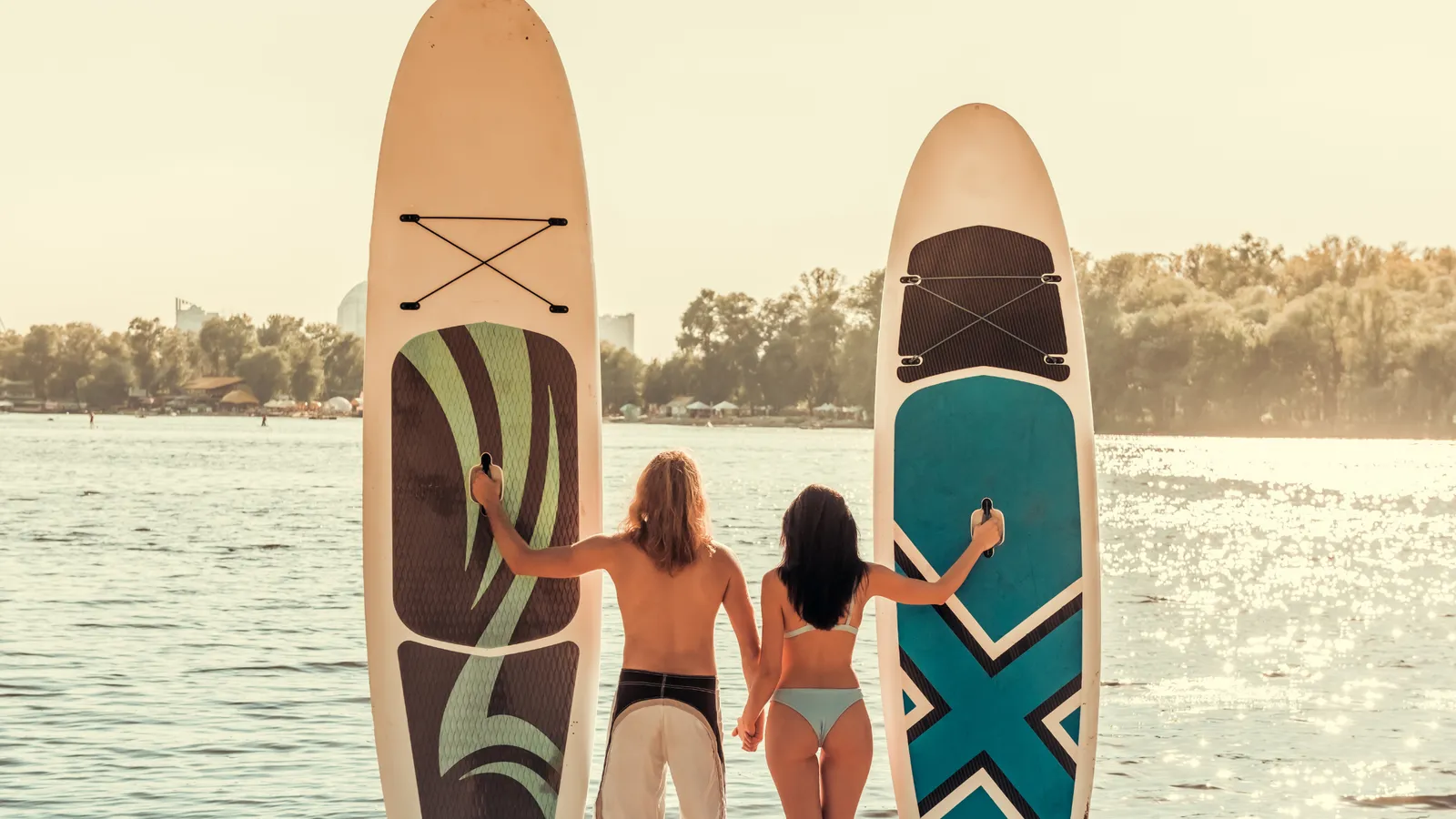
Length decides how a board moves. Short boards turn easily. Long boards go straighter and faster but take more effort to turn, store and carry.
Under 10 feet: surfing and kids
- Turns quickly, which is what you want on a wave.
- Usually a planing hull (flat, like a surfboard).
- A good size for kids up to about 13.
- Less stable and slower for adults on flat water, so not a first board for most grown-ups.
10 to 11 feet: all-round, yoga and fishing
- The most popular size, and the one we recommend for most first boards.
- Stable enough to learn on and short enough to turn and carry.
- Works for cruising, paddle board yoga, fishing and paddling with a dog.
- Mostly planing hulls, though some all-round boards have a pointier displacement nose.
12 feet and over: touring and racing
- Tracks straighter, glides further per stroke, and is faster.
- Usually a displacement hull, with a pointed nose that cuts through water.
- Best for experienced paddlers covering distance. They’re harder to turn and to balance on if they’re narrow.
ISLE’s size chart lands in the same places: around 9′–10′6″ for surfing, 10′–12′ for all-round, and 11′6″–14′ for touring and racing.
Width: pick it by experience
Width is the biggest factor in how stable a board feels.
- Beginners: 32–34″. Wide enough to stand up without a fight. Heavier beginners should sit at the 34″ end.
- Experienced paddlers: 30–32″. Narrower boards are faster and easier to paddle, because your stroke stays closer to the rail.
- Yoga and fishing: 33″ or wider. You need a steady platform when you’re kneeling, stretching, casting or reeling.
- Multi-person “group” boards are much wider again, often 45″ or more.
Don’t overdo it. On a board that’s too wide for your height, you have to reach out to the side to get the paddle in the water, which is tiring and makes the board zig-zag.
Thickness
- Inflatables: about 6″. Thinner inflatables flex and sag in the middle under an adult. A 4–4.5″ inflatable is generally only for kids and light paddlers.
- Hard boards: usually about 4–5″. A hard board doesn’t flex, so it doesn’t need to be as thick.
Thicker boards carry more weight, but they also sit you higher off the water, which can feel a little less stable.
Volume and weight capacity
Volume, in litres, tells you how much a board floats. Weight capacity, in pounds, is the manufacturer’s limit on what it can carry. Both matter more as your weight goes up.
When you work out your load, add up:
- your weight,
- any passenger (a kid, or a dog plus a little extra to allow for it moving around),
- your gear: cooler, dry bag, fishing kit.
Then leave plenty of room. A board loaded near its maximum sits low, drags and feels sluggish. BOTE, for example, suggests sizing up if you’re within 50 lb of a board’s capacity. ISLE points out that you can’t really be too light for a paddle board. The cost of going big is mostly weight, speed and turning, not safety.
Our sizing rules keep raising the volume as weight climbs, and above 235 lb we never go below about 0.9 litres per pound of total load (so at least about 250 L at 275 lb and 270 L at 300 lb), however experienced you are. Those are floors. Beginners, and anyone on an inflatable, will usually want more. Glide’s sizing guide, for instance, works on about 1.5 litres per pound for beginners, about 1.2 for intermediate paddlers and about 1 for advanced. Our best paddle boards for big guys roundup covers boards built for heavier loads.
A tip for inflatables: many brands don’t publish volume at all. In that case go by the weight capacity, the width and the thickness.
Inflatable or hard board?
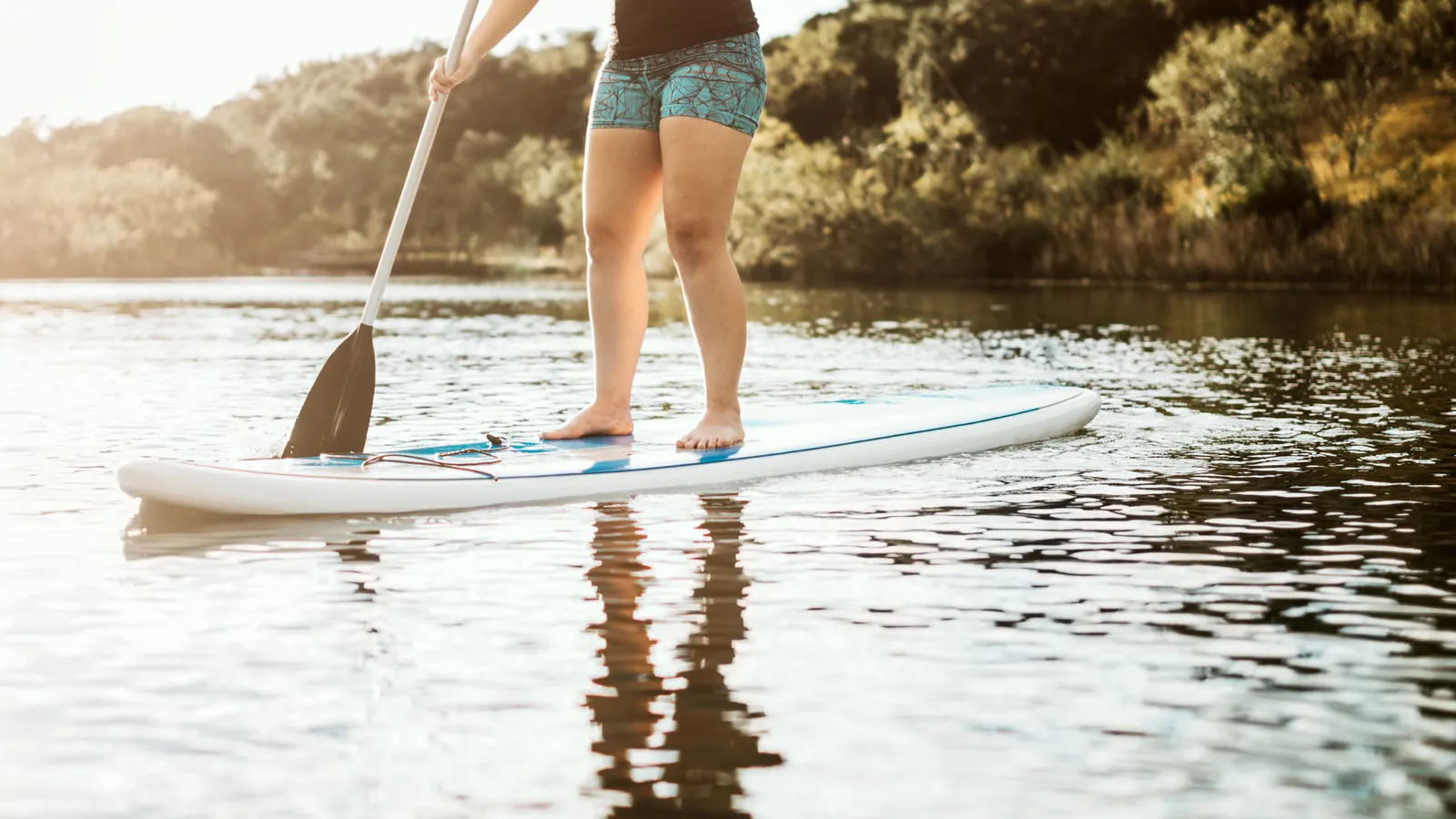
Size works the same way for both, but the build changes the numbers a little.
- Inflatable: easier to store and transport, softer to fall on, and usually cheaper. Best for beginners, yoga and travel. Choose about 6″ thick.
- Hard board: stiffer, faster and better in waves and wind. Best for touring and surfing if you have space to store it.
Our guide to what to look for in a paddle board goes deeper on build quality, fins and accessories.
Sizing for experienced paddlers
Once you can stand up, turn and handle a bit of chop without thinking about it, a narrower and lower-volume board will feel faster and more fun.
- Drop to 30–32″ wide.
- Choose length by use: shorter for surf, longer for distance.
- Keep the same rule on capacity. Being experienced doesn’t make an overloaded board paddle better.
Sizing with a kid or a dog
Add their weight to yours when you check volume and capacity. With a dog, add a little more than the dog weighs, because it’ll move around. Go 33″ or wider so you both have room. Our guides on paddle boarding with a dog and with a baby cover the rest, including life jackets for both of you.
FAQ
What size paddle board does a beginner need?
Most adult beginners do well on a board about 10′–11′ long and 32–34″ wide. If you weigh more than about 200 lb, pick the 34″ end and check the weight capacity leaves plenty of room. The Board Fitter will narrow it down for your weight.
Is it better to get a bigger or smaller paddle board?
For your first board, a little bigger is better. The most common mistake is buying a board that’s too narrow or too small, which makes balancing hard and learning frustrating. Size up in width first; extra length mostly makes a board harder to turn and carry.
Does my height matter?
Less than your weight. Taller paddlers have a higher center of gravity, so a slightly wider board can help, but weight and use matter far more. Height matters most for paddle length.
What size paddle board for a 200 lb person?
On our sizing rules, a 200 lb beginner on an all-round board would look at about 10′6″–10′10″ by 34″. That’s roughly 280 L for an inflatable, and 190 L or more for a hard board. Check the weight capacity is comfortably above 200 lb plus gear.
Can two people share one board?
Yes, if you add both weights and stay well inside the capacity. Regular 10′6″ boards suit an adult with a small child or dog. For two adults, look at tandem or group boards, which are longer and wider.